

Mutual Fund Investment Strategies That Work in 2026
Investing in mutual funds in 2026 isn’t about chasing trends – it’s about combining discipline, diversification, and smart asset allocation. With evolving global markets, digital innovation, and economic cycles, investors need strategies that balance growth and stability.
Here’s a practical guide to mutual fund strategies that are working in 2026.
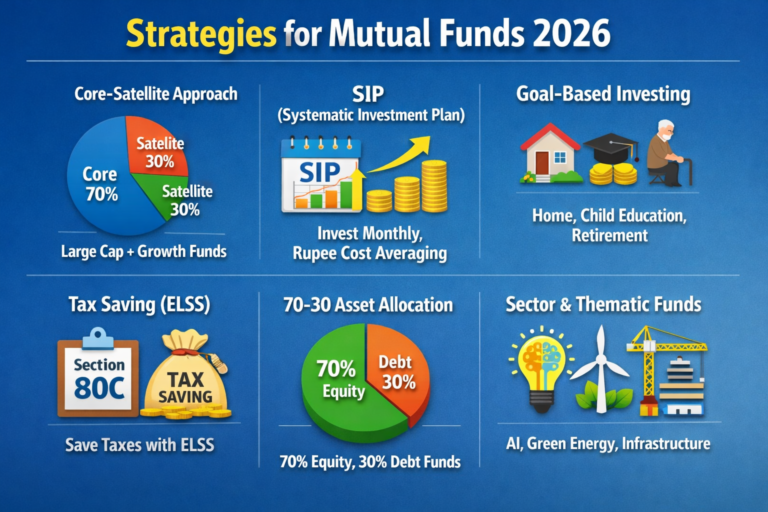
1. Core–Satellite Strategy (Balanced & Smart)
Best for: Long-term investors seeking stability + growth
The Core–Satellite strategy remains one of the most effective approaches in 2026.
🔹 How It Works:
Core (60–80%) – Low-cost index funds or large-cap mutual funds
Satellite (20–40%) – High-growth funds like sectoral, mid-cap, small-cap, or thematic funds
✅ Why It Works in 2026:
Keeps costs low
Reduces volatility
Allows tactical exposure to high-growth sectors like AI, green energy, and digital infrastructure
2. Systematic Investment Plan (SIP) – The Power of Consistency
Best for: Salaried individuals & disciplined investors
SIPs continue to outperform emotional investing strategies.
🔹 Why SIPs Are Powerful in 2026:
Markets remain volatile due to global uncertainties
Rupee-cost averaging reduces timing risk
Compounding works best over 10–20 years
Pro Tip:
Increase your SIP amount annually by 10–15% to match income growth.
3. Goal-Based Investing (Strategy Over Speculation)
Best for: Investors with specific financial milestones
Instead of investing randomly, align each fund with a goal:
🏠 Home purchase (5–7 years)
🎓 Child’s education (10–15 years)
👵 Retirement (20+ years)
Recommended Allocation Approach:
Short-term goals → Debt or Hybrid funds
Medium-term goals → Balanced advantage funds
Long-term goals → Equity mutual funds
This reduces stress and improves clarity in portfolio decisions.
4. Diversified Equity + Debt Allocation (The 70–30 Rule)
Best for: Moderate risk investors
A 70% equity and 30% debt allocation is working well in 2026 due to:
Rising but stabilizing interest rates
Equity market growth with periodic corrections
Debt funds offering stable returns
You can adjust:
80–20 (Aggressive)
60–40 (Conservative)
5. Index Funds & Low-Cost Investing
Best for: Investors who prefer simplicity
With increasing awareness about expense ratios, passive investing is booming in 2026.
Why It Works:
Lower fees
No fund manager bias
Consistent performance with the market
Index mutual funds tracking broad markets are ideal as a long-term core holding.
6. Sector & Thematic Funds (Selective & Tactical)
Best for: Experienced investors
In 2026, key themes include:
Artificial Intelligence
Renewable Energy
Infrastructure Development
Healthcare Innovation
⚠️ Keep exposure limited to 10–15% of your portfolio to manage risk.
Common Mistakes to Avoid
❌ Timing the market
❌ Chasing last year’s best-performing fund
❌ Ignoring expense ratios
❌ Over-diversification
❌ Stopping SIPs during market corrections
Final Thoughts
The best mutual fund strategy in 2026 isn’t about predicting markets — it’s about:
- Asset allocation
- Consistency
- Diversification
- Low costs
- Long-term discipline